
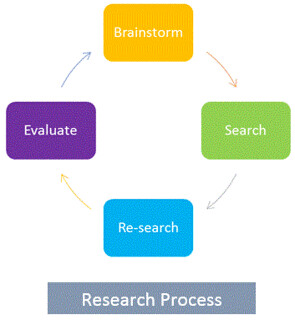
Brainstorm about your topic. Write down what you know about the topic and questions you have about it. You can use concept maps to help you and to generate keywords you can use in your search.
Remember to think about synonyms too. For example, "global warming" and "climate change" are both useful search terms for that topic.
Search using the most obvious terms. Use some of the keywords from your brainstorming.
Re-search is when you use search strategies to get more, fewer or more relevant results.
Too many results? Try using AND, subject headings or phrase searching
Too few results? Try using OR, synonyms, related words or truncation
Tip: Use the first good article you find to help you find better ones. It can give you some new search terms to try and subject headings.
Many different methods have been developed over the last few decades to help us determine if a source of information is credible and reliable.
The pages in this box detail three common methods used for evaluating information.

The CRAAP Test is a checklist with questions you can ask about a source to help you evaluate.
How old or new is the information?
Does the information address your topic, thesis, and supporting arguments?
Who wrote the information and what are their credentials? Who is responsible for the information?
Is the information consistent with other sources? Does it seem bias? Are there spelling or grammar mistakes?
Why was the information created? To persuade, educate, or sell something?
Lateral reading helps uncover information about an organization, website, author, or publication. Instead of scrolling down on a website or checking the About Us pages, try finding out what others are saying about it.

The SIFT Method, developed by Mike Caulfield, is step-by-step process to help uncover the truth behind a website, image, video, or online source.

SIFT Method Graphics from Chapter 17: The SIFT Method Introduction to College Research